CEO Succession Patterns among Russell 3000 Banks (2020-2025)

Key Takeaways
- Succession planning has become a core responsibility of compensation committees, as boards increasingly oversee broader human capital matters amid persistent market volatility, deeper regulatory scrutiny, and rapid industry change.
- CEO succession among Russell 3000 banks reflects a predominantly planful talent pipeline, with approximately two‑thirds of CEOs hired from COO or President roles – positions often intentionally structured as stepping-stones to the top job.
- Internal promotion dominates leadership development, with 71% of COOs/Presidents hired from within, most commonly from senior banking, lending, and CFO leadership – underscoring the value boards place on deep operational, financial, and enterprise oversight experience.
- External hiring serves as a targeted complement to internal succession planning, often through former CEOs or M&A‑related appointments, reflecting a flexible approach to selectively augment internal pipelines with high‑potential external talent where strategically appropriate.
- Boards and compensation committees across industries should consider the approaches – such as succession planning cadence, incentive design for “CEO-in-Waiting” roles, and targeted development investments in COOs/Presidents and other executive pipelines – that encourage greater proactivity, streamline succession processes, and strengthen long-term leadership outcomes.
- Compensation committees can deploy a suite of succession‑linked pay tools – including pre‑CEO retention RSUs, pre‑approved compensation step‑ups, and promotion awards – to support continuity, reduce flight risk, introduce pay certainty ahead of transition, and reset long‑term incentives in a manner that aligns incoming CEOs with enterprise‑wide accountability.
Introduction
As compensation committees become more engaged in broader human capital matters, succession planning has increasingly fallen within their purview. The banking industry provides a clear example, where CEO succession has drawn increased attention in recent years as institutions navigate post-pandemic volatility, heightened regulatory scrutiny, and rapid technological change. Coupled with a broader, cross-industry shift toward hiring first-time CEOs and promoting from within, the need for thoughtful succession planning is more critical than ever.
What are the Most Common Career Pathways to the CEO Role?
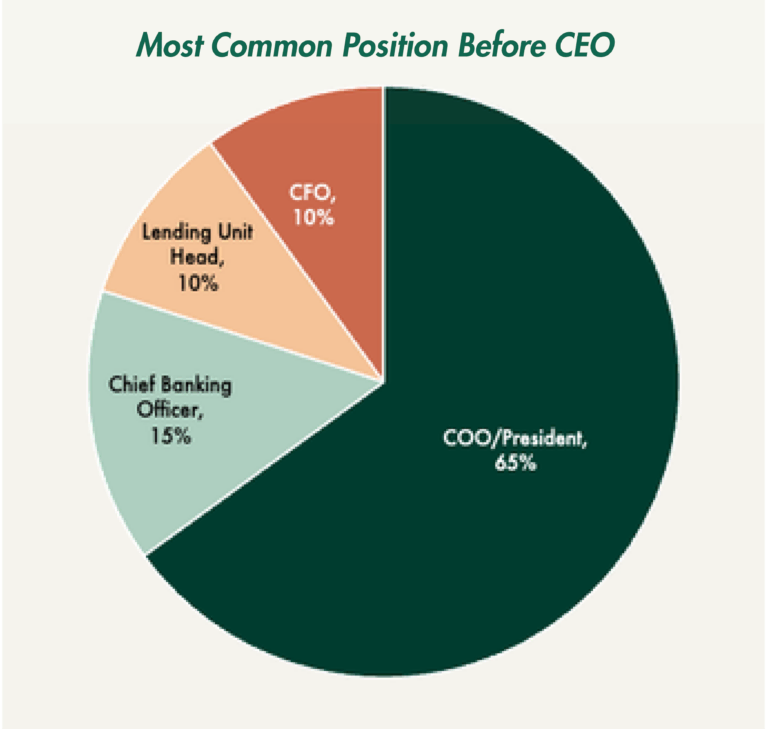
To evaluate banking-sector dynamics and identify potential broader market patterns, we analyzed 93 CEO changes among Russell 3000 banks between 2020 and 2025. The data show that approximately two-thirds of current CEOs were previously in a COO or President role before taking the top job, suggesting that experience running a company at the corporate level is valued by boards of directors. The other one-third of incoming CEOs came from chief banking, lending, or finance roles.
The majority of CEO hires were drawn from COO/President roles, highlighting planful succession design is the norm. These roles are often intentionally positioned as stepping-stones on the CEO track, with the COO/President role owning the business internally (e.g., lending oversight, operations) and the CEO owning it externally (e.g., investor relations, M&A).
What Career Pathways Typically Lead to the COO/President Role Prior to CEO Appointment?
71% of COOs/Presidents were internal promotions, while 29% were external hires. This distribution further supports that succession pipelines are primarily built from within, with external talent selectively introduced at key leadership inflection points.
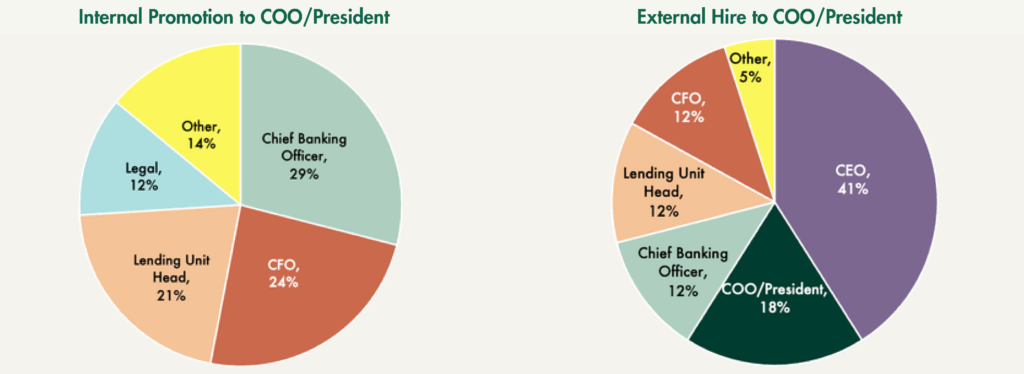
For internally promoted COOs/Presidents, feeder roles were concentrated in several core leadership positions, with Chief Banking Officer being the most common (29%), followed by CFO (24%) and Lending Unit Head (21%). These findings suggest that boards value deep functional expertise, financial stewardship, and direct profit-and-loss responsibility as foundational preparation for broader enterprise oversight.
The profile differs meaningfully for externally hired candidates. Among this group, 41% came from CEO roles. The remaining external hires were distributed across COO/President (18%), banking (12%), lending (12%), and CFO (12%) roles.
Further analysis of external hires provides additional context. Approximately 60% of external appointments into COO/President roles occurred in connection with M&A activity. Among these examples, 24% came from smaller companies, 35% came from larger companies, and 41% were from similarly-sized companies. This research highlights that there is no “typical” approach to external recruiting – companies take multiple strategies to supplement their existing executive rosters with high-potential leaders.
Overall, CEO succession patterns among Russell 3000 banks between 2020 and 2025 reflect a mix of thoughtful planning and opportunistic hiring. The most common pathway to CEO was from the COO/President seat where the incumbent had progressed internally, reinforcing the importance boards place on enterprise-wide leadership experience. At the same time, companies selectively hired externally – often with prior CEO experience – to supplement internal bench strength. Taken together, these findings highlight that succession outcomes are largely shaped well before a CEO appointment, through strategic organizational design decisions that bolster leadership pipelines.
What are the Implications for Boards and Compensation Committees?
In light of these findings, boards and compensation committees can more deliberately influence succession outcomes by applying governance strategies earlier in the leadership lifecycle. Across industries, committees should assess whether their succession planning cadence, incentive design for CEO feeder roles, and leadership‑development investments appropriately reinforce roles and experiences most critical to enterprise leadership readiness. Aligning incentives, development priorities, and performance expectations at these levels helps ensure that successors are prepared long before a transition becomes imminent, while preserving flexibility to introduce external talent at key inflection points. This approach enables boards not merely to respond to CEO vacancies, but to actively shape succession outcomes through sustained, forward‑looking talent stewardship.
How Do We Plan for This?
Once an executive is on a clear succession path to CEO, compensation design can become an important tool for reinforcing commitment and managing the transition.
Approaches we have observed in the market include:
- Pre‑CEO Retention RSUs – used to support continuity and mitigate flight risk during the period leading up to a promotion.
- Compensation “Step-Ups” – enable committees to pre‑approve increases in salary, annual incentive opportunity, and long‑term incentive targets, providing clarity and avoiding renegotiation at the point of transition.
- Promotion Awards – granted in connection with the CEO appointment to reset long‑term incentives and formally align compensation with enterprise‑wide accountability.
When thoughtfully integrated into a broader succession framework, these tools enable boards to reinforce planful leadership transitions and support long‑term organizational stability.