Beyond Barrels: Incentive Design for Disciplined E&P Value Creation

KEY TAKEAWAYS
- Use the annual incentive plan to influence management decisions, not simply to reflect common market practice.
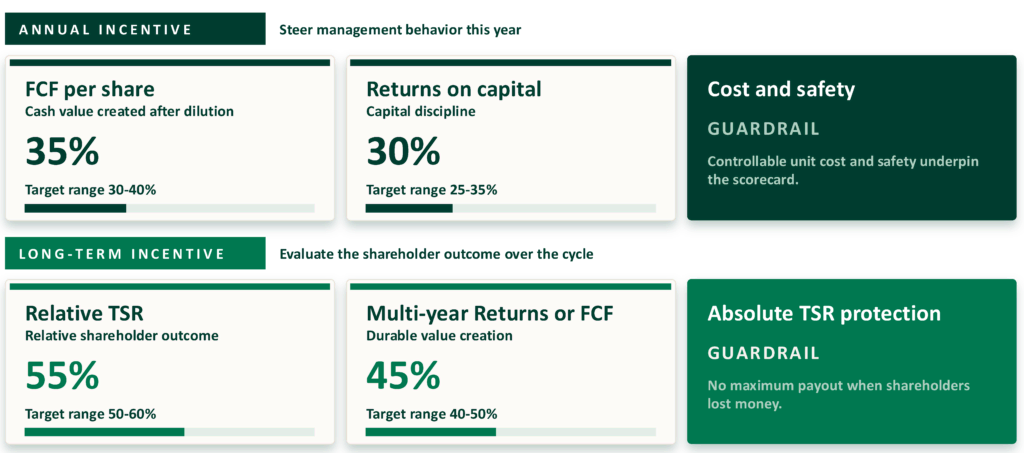
- Give meaningful weight to cash generation per share, capital efficiency, cost control, and safety.
- Avoid rewarding production growth unless the scorecard also shows whether that growth earned an acceptable return.
- Retain relative TSR as an important long-term shareholder outcome measure, but pair it with an absolute TSR guardrail and, where appropriate, a multi-year returns measure.
- Review performance peer groups regularly so consolidation and sector changes do not weaken the relevance of relative comparisons.
- Apply Committee judgment to ensure payouts remain defensible when commodity prices, growth, or relative performance are strong, but absolute value creation is weak.
For Compensation Committees in the E&P sector, the incentive design question has moved beyond whether to include value-oriented measures. Most companies already do. The harder question is whether the plan supports the right conversations with management during the year: what level of production is worth funding, how much cash should be reinvested, what should be returned to shareholders, and whether the growth being pursued is earning an acceptable return.
In our work with Committees, the better scorecards are rarely just a collection of common market metrics. They are used as a governance tool. They make clear the trade-offs directors expect management to manage, including cash generation versus reinvestment, production growth versus capital efficiency, relative performance versus absolute shareholder outcomes, and annual operating progress versus long-term value creation.
The E&P sector has clearly moved away from simple production growth as the lead compensation message. Most companies now use broader annual scorecards and relative TSR-based long-term incentives. That is progress, but it does not fully answer the design question. Based on the research and what we see in practice, annual incentives are more effective when they point management toward free cash flow per share, disciplined capital allocation, and returns on invested capital. Long-term incentives should continue to include relative TSR as the main shareholder outcome measure, with guardrails to avoid outsized payouts when absolute returns are negative.
The point is not to move away from relative TSR. It remains an important shareholder alignment measure. The issue is that relative TSR cannot do all the work. It tells the Committee whether shareholders did better or worse than the peer group over the period. It does not tell management, in real time, which operating choices to make during the year. That role belongs in the annual plan, where the measures should be tied to capital discipline, cash generation per share, cost control, and safety.
What the Data Says about Value Creation (Pay Governance study of 32 US E&P companies)
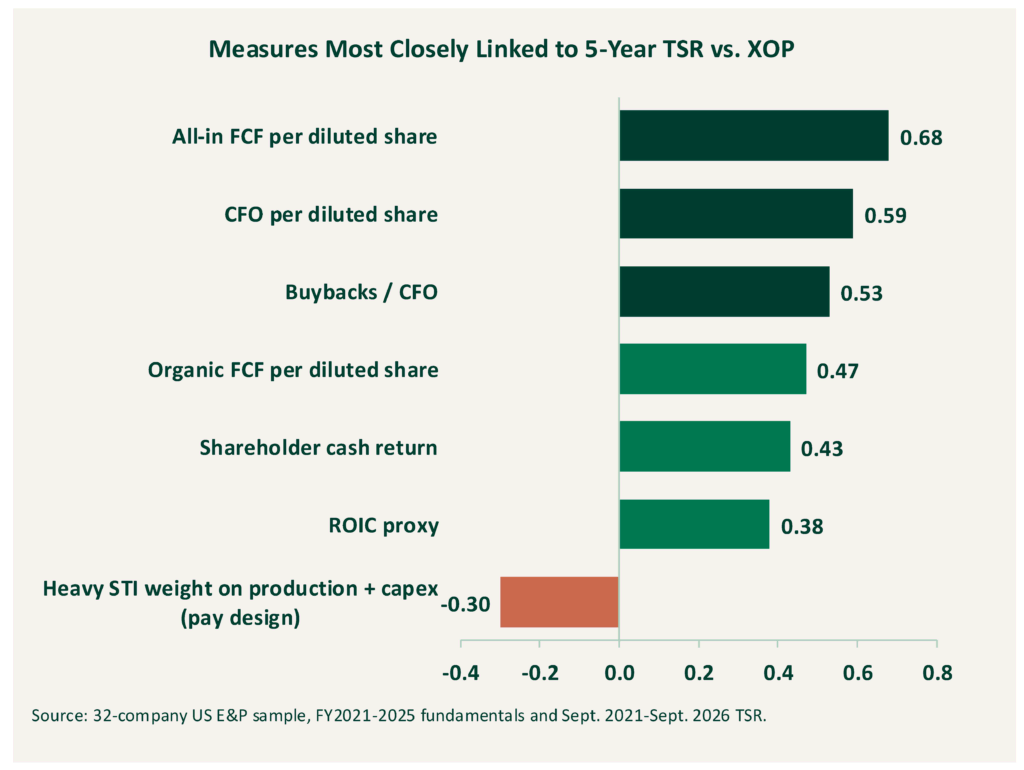
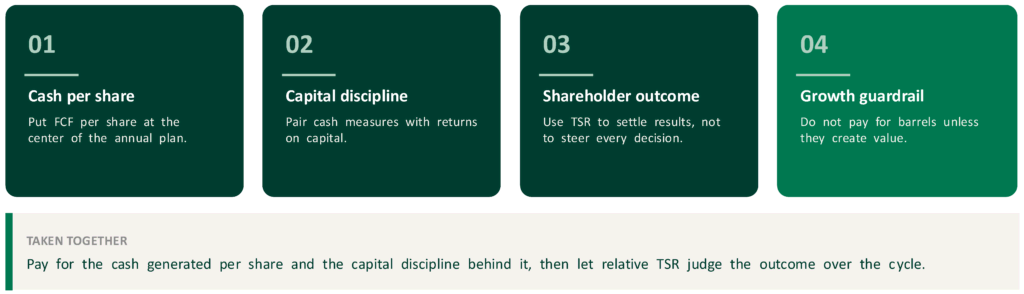
1. Cash generation per share has the strongest link to shareholder outcomes
In our five-year E&P sample, free cash flow per diluted share had the strongest relationship with shareholder returns relative to XOP. Operating cash flow per share, organic FCF per share, and the portion of cash flow used for share repurchases also had meaningful relationships. We would not use the repurchase ratio as a stand-alone incentive measure, but it does provide some evidence of capital allocation discipline. Taken together, the results support a point investors have made for several years: cash generation per share and a disciplined approach to returning capital matter.
The other measures in the study did not separate stronger and weaker performers as clearly. Asset growth, reinvestment rate, cash flow on assets, and share-count change were not consistent differentiators. We do not read that as an argument against growth. The more practical conclusion is that investors distinguish between growth that earns an acceptable return and growth that only makes the company larger.
2. FCF helps, but plan design determines whether it matters
Many companies now include cash flow, free cash flow, ROCE, CROCE, or similar value-oriented measures in the annual plan. That is a positive development, but simply including the measure is not enough. Its definition and goals need to be credible, and it needs enough weight to influence behavior. It also should not be offset by volume or capex measures that can pay well even when capital discipline is weak.
In our experience, the better annual plans are not the ones with the most financial measures. They use a limited set of measures to make the trade-offs among volume, capital intensity, cost, and cash return visible to both the Committee and management. FCF per share can be particularly useful because it reflects both cash generation and dilution.
3. Volume measures can quietly undermine capital discipline
Production remains important operationally, but it should rarely be the dominant incentive message. A production measure can make sense when it is tied to an approved capital plan, stated on a per-share basis, or balanced by returns and capital efficiency. It becomes a problem when production can pay at high levels even if the capital program or returns outcome falls short.
For plan design, the Committee should be reluctant to pay for barrels before it is satisfied that the barrels created value. Measures tied to activity, scale, or reinvestment can be appropriate, but only when the related cash return and capital discipline are also visible in the scorecard.
Two Design Traps to Avoid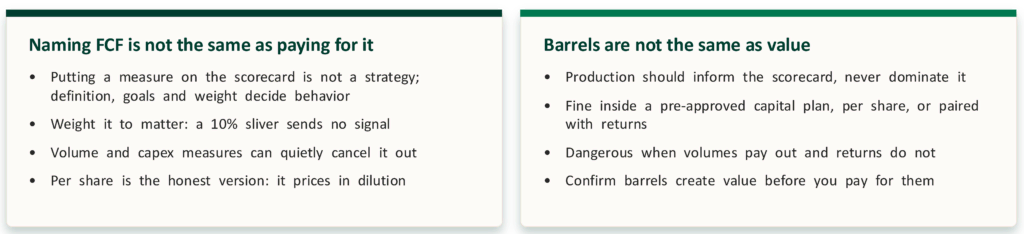
4. LTI design: relative TSR needs an absolute check
The first three observations focus primarily on measures used in the annual incentive plan. The long-term incentive program serves a different purpose: evaluating whether management’s decisions produced durable value for shareholders over several years. Relative TSR remains useful in that context because it ties payouts to the shareholder experience versus the sector. We tend to view it as more of an outcome measure than a management tool. It can confirm whether shareholders were rewarded relative to peers, but it does not show whether the company created an acceptable return in absolute terms.
An absolute TSR guardrail can make the relative TSR result more credible by reducing or capping the payout when shareholders lost money, even if the company ranked well against a declining peer group. It avoids the difficult outcome of paying above target simply because the company was the best performer in a weak market. A multi-year returns measure, such as ROCE or CROCE over the performance period, can address a different question: did management earn an acceptable return on the capital it put to work? Relative TSR, an absolute TSR guardrail, and a multi-year returns measure each serve a distinct purpose. Together, they give the Committee a better view of long-term performance without placing too much weight on any one result.
Performance peer group construction also deserves regular attention. In a sector that routinely experiences consolidation, small custom peer groups can become stale quickly. Committees should review peer sets regularly and may want to supplement a focused operating peer group with a broader sector reference point such as XOP.
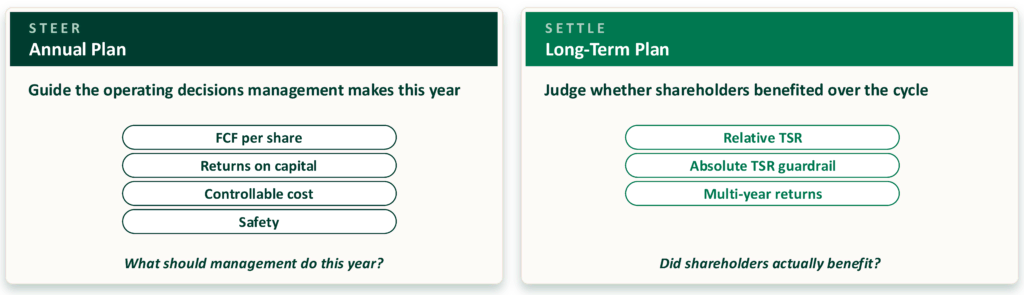
Turning the Findings into Better Plan Design
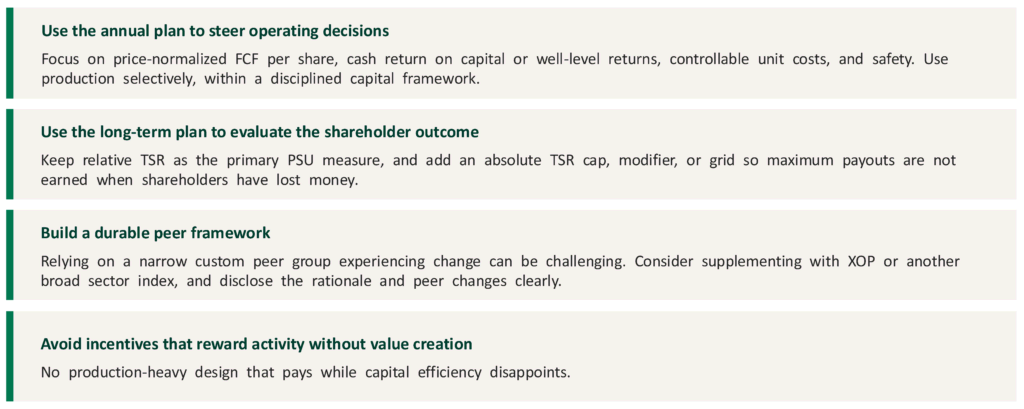
A Practical Framework for STI and LTI Design
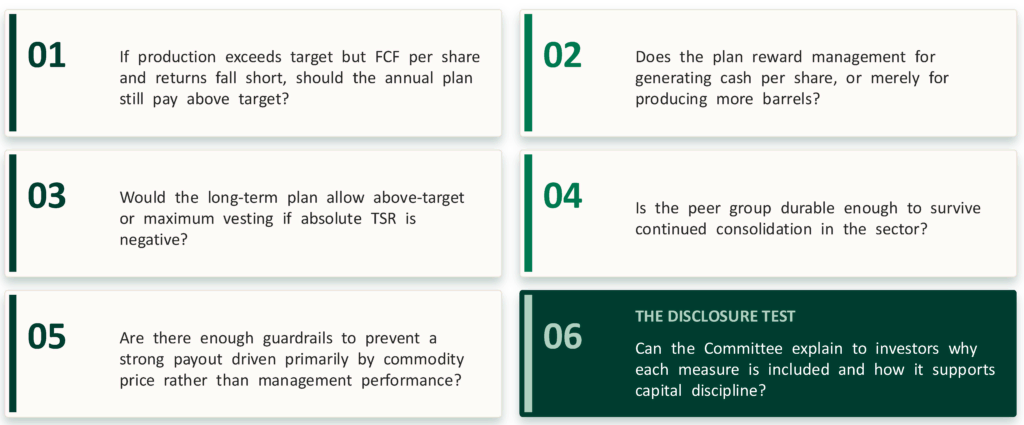
Questions Every Committee Should Ask
Research Basis and Methodology
The analysis covers 32 US-listed operating E&P companies. We reviewed FY2021 through FY2025 fundamentals, shareholder returns from September 2021 through September 2026, proxy disclosures from 2024 through 2026, and the measures used in annual incentive scorecards. Within this sample, FCF per diluted share, CFO per diluted share, cash returned to shareholders, and returns on capital had the strongest relationships with five-year shareholder returns relative to XOP. Companies with production-heavy annual plans and long-term plans based only on relative TSR generally had weaker relative outcomes. The sample is not large enough to support broad causal claims, so we view the findings as directional. Even with that limitation, the results are consistent with what we hear from investors and discuss with Committees: incentive plans should reward disciplined cash generation and capital allocation, not growth for its own sake.
Closing Perspective for Compensation Committees
We are not suggesting that every E&P company should use the same measures or weights. The right design will depend on the business plan, asset base, balance sheet, and shareholder priorities. The Committee should still be able to explain what decisions the annual plan is intended to influence and what outcomes the long-term plan is intended to assess. Strong payouts should be difficult to earn from growth, commodity price, or relative performance alone when absolute value creation is weak.
That is where Committee judgment matters most. Measures provide structure, but they do not answer every question. Directors still need to consider whether the plan encourages the right operating choices, whether payouts will remain defensible across commodity price environments, and whether the overall result can be explained to shareholders. For E&P companies, the design principle is simple: reward disciplined cash generation, capital efficiency, and shareholder value creation rather than activity for its own sake.
Key Terms
- CFO: Cash flow from operations
- CROCE: Cash return on capital employed
- E&P: Exploration and production
- FCF: Free cash flow
- LTI: Long-term incentive
- ROCE: Return on capital employed
- rTSR: Relative total shareholder return
- STI: Short-term incentive
- TSR: Total shareholder return
- XOP: SPDR S&P Oil & Gas Exploration & Production ETF, used as a broad sector benchmark
| Committees should favor incentive frameworks that reward profitable cash generation, capital efficiency, and disciplined reinvestment, rather than growth for its own sake. The annual plan should influence the choices management makes during the year. The long-term plan should then assess whether those choices produced a strong shareholder outcome. |