Executive Security and Protection Continues to Expand

KEY TAKEAWAYS
- Personal security benefits are becoming more common. Among S&P 500 companies, prevalence of CEO personal security increased from 35% to 54% year over year, while approximately 47% of companies now provide personal security to at least one additional named executive officer (NEOs).
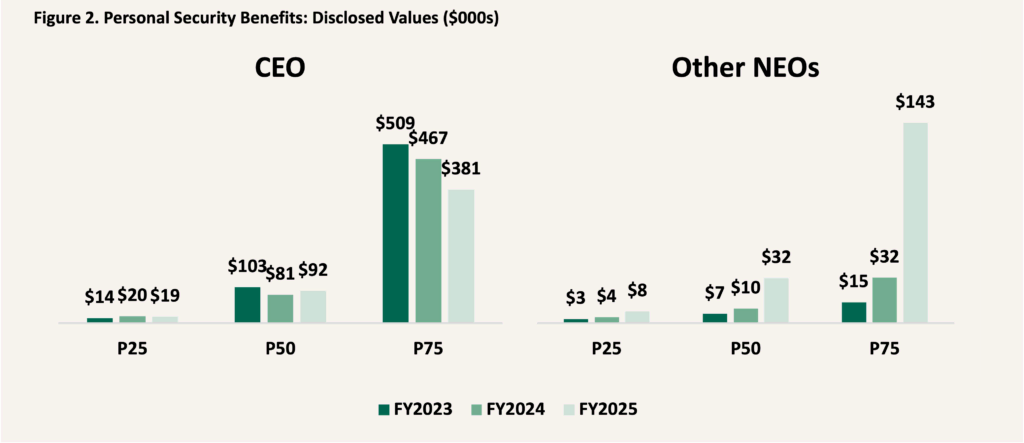
- Growth is most pronounced below the CEO level. Median personal security values for other NEOs rose from approximately $10K to $32K, while the 75th percentile increased from approximately $32K to $143K.
- Security programs are becoming more multidimensional. Based on most recent 2026 proxy disclosures, there are increased references to digital protection, cybersecurity monitoring, online privacy services, personal data removal, home network monitoring, and independent risk assessments.
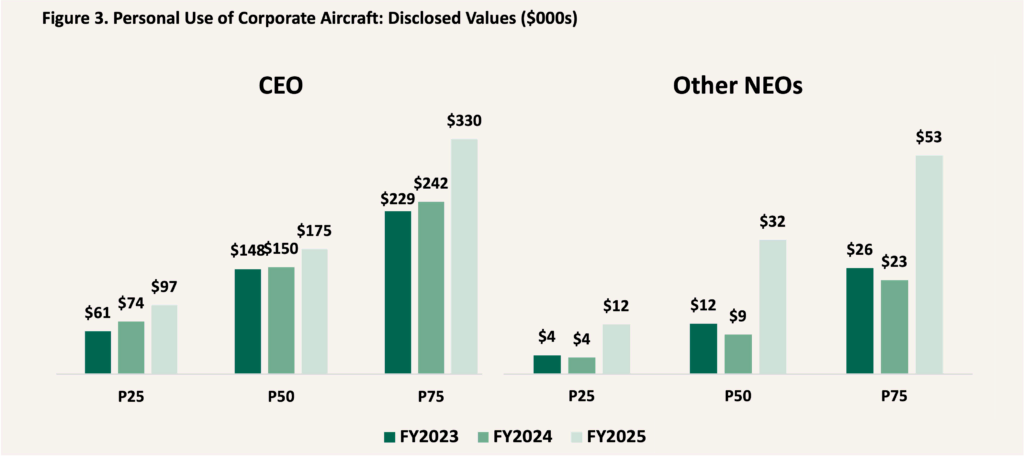
- Personal Aircraft usage values increased. CEO aircraft usage values increased 17% at the median and 37% at the 75th percentile, with meaningful increases also reported for other NEOs.
- Disclosure quality is improving. Disclosures increasingly address digital security, independent risk assessments, and governance oversight.
Introduction
Executive personal security and corporate aircraft usage are becoming more prominent, resulting in more complex executive compensation disclosures. After the murder of a high-profile healthcare insurance company executive in December 2024, many large companies commissioned security reviews by outside experts. In some cases, these reviews resulted in increased personal security measures. Historically concentrated around the CEO, these programs are increasingly extending to other named executive officers (NEOs) and are being described through a more formal risk-management lens. This expansion comes amid heightened concern for executive safety, as other recent events and executives’ growing public and digital visibility have prompted many boards to reassess whether existing protection programs remain appropriately scoped and sufficiently robust. At the same time, personal security and corporate aircraft usage are becoming more connected, with some companies requiring personal aircraft use as an extension of board-approved security policies rather than a standalone perquisite.
Our findings suggest that executive protection programs are continuing to mature. The most notable development is not simply higher disclosed values for CEOs, but the wider expansion of these programs to select members of the leadership team, supported by stronger governance practices and more detailed proxy disclosure.
Personal Security Programs Continue to Expand
Personal security programs have continued to expand across the S&P 500 over the past three years. While CEO arrangements remain the most prevalent, one of the clearest findings from our review is the growing use of executive protection benefits for other named executive officers. As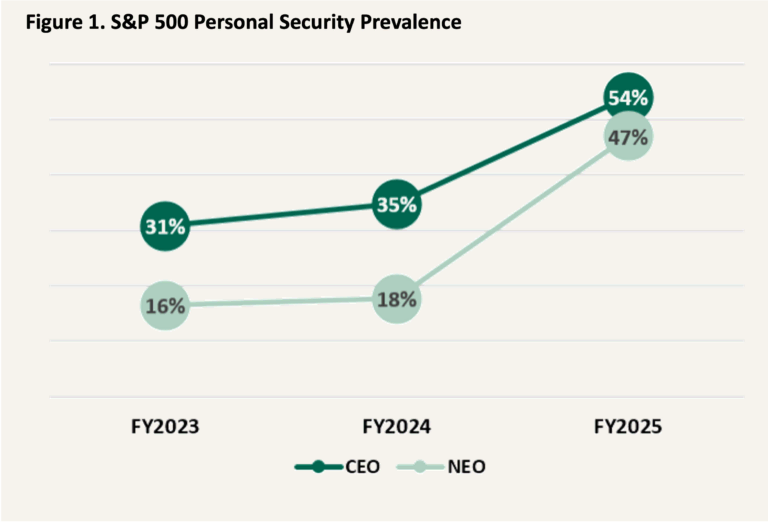 shown in Figure 1, approximately 47% of S&P 500 companies now provide personal security benefits to at least one additional NEO, compared with fewer than 20% in both FY2023 and FY2024.
CEO personal security values were mixed in FY2025. The median increased approximately 14%, while the 75th percentile declined 18%. At the same time, prevalence increased from 35% to 54%. This dynamic may also reflect a shift in the types of protections being disclosed. As more companies adopt lower-cost measures such as digital monitoring, privacy protection, identity theft protection, and home network security, overall prevalence can rise even while median or upper-quartile values remain more modest.
The increase was more pronounced for other NEOs. As shown in Figure 2, median personal security values rose from approximately $10K to $32K, while the 75th percentile increased from $32K to $143K. This suggests that companies are increasingly viewing executive protection for select executives, rather than a benefit reserved only for the CEO.
Unlike the CEO population, where increasing prevalence appears to be driven primarily by broader adoption at more moderate spending levels, some of the NEO population has experienced growth in both prevalence and higher-value programs. Specifically, the number of NEOs receiving more than $100,000 in personal security benefits increased from 18 in FY2024 to 57 in FY2025, contributing to the significant increase in the 75th percentile. By comparison, the number of companies providing CEO personal security benefits exceeding $500,000 remained unchanged at 29 in both FY2024 and FY2025, suggesting that the increase in CEO prevalence was driven more by broader adoption at typical spending levels than by growth among the highest-paying programs.
Emerging Trends in Executive Security Perquisites
FY2025 proxy disclosures show personal security evolving beyond traditional physical measures such as home alarm systems, residential security personnel, secure transportation, and travel protection. Companies are increasingly describing broader, risk-based executive security programs that include independent security assessments, enhanced residential protections, and Board- or Committee-supported security arrangements. The disclosure language also more frequently frames these costs as necessary business protections tied to executive visibility, threat environments, and company risk management, rather than simply as personal benefits.
Beyond physical measures, the same FY2025 proxy disclosures show a continued expansion of personal security into digital and cyber-related protection. Compared with prior years, companies are more explicitly disclosing services such as digital executive protection, cybersecurity monitoring, identity theft protection, online privacy services, personal data removal, home network monitoring, and data protection for executives and, in some cases, their families. This shift is important because it extends the traditional understanding of executive security beyond physical protection. For many companies, executive security now includes reputational, digital, residential, and travel-related risk mitigation.
Personal Use of Corporate Aircraft Shows More Consistent Value Growth
Corporate aircraft usage followed a different pattern than personal security. In contrast to personal security, corporate aircraft is a more established benefit: approximately 57% of S&P 500 CEOs and 32% of other NEOs were provided with personal use of corporate aircraft in FY2025, and the year’s growth was concentrated in disclosed values rather than in broader adoption. While personal security growth was largely driven by broader adoption and expansion beyond the CEO, aircraft usage values increased more consistently in FY2025.
CEO aircraft usage values rose 17% at the median and 37% at the 75th percentile. Aircraft usage values for other NEOs also increased, with the median more than tripling and the 75th percentile rising from approximately $23K to $53K, as shown in Figure 3. This increase is likely due to independent security assessments, that, in some cases, required CEOs and select NEOs to travel on private aircraft to comply with more stringent safety policies being implemented.
A Market-Wide Expansion in Executive Protection
Although the prevalence and value of executive protection programs continue to vary by company and industry, FY2025 reflected broad-based growth. Every industry sector included in our review experienced increases in either the prevalence or disclosed value of personal security or aircraft usage benefits. Rather than viewing this as a sector-specific development, the data suggests a broader market shift. Certain industries may continue to report higher values due to business model, executive visibility, headquarters location, travel patterns, or risk profile, but the overall direction of change was notably consistent.
Looking Ahead and Committee Considerations
Executive protection is likely to remain an important area of Board and Compensation Committee oversight. Given the elevated risk environment and expanding program scope, prevalence and disclosed value may continue to increase, particularly for certain executives beyond the CEO. The SEC is actively reconsidering whether executive personal security should be treated as a “perk” for disclosure purposes, but no specific changes have been outlined yet. Major shareholders and proxy advisors appear to be focused less on the existence of these benefits alone and more on whether companies provide a clear rationale, disclosure, document appropriate oversight, and explain how the arrangements support shareholder interests.
For Compensation Committees, several practical considerations follow:
- Ground programs in a formal security assessment. The strongest programs are supported by an independent, periodic security assessment rather than ad hoc decisions. This helps establish the appropriateness of the benefit, supports the company’s business rationale, provides consistency of application for the affected team members, and provides a stronger foundation for shareholder disclosure.
- Clearly explain the business rationale. Compensation Discussion and Analysis (CD&A) disclosure should explain how security and aircraft benefits relate to the executive’s role, visibility, travel requirements, threat environment, and broader company risk management. This framing helps distinguish the program from a purely personal perquisite.
- Evaluate tax gross-ups carefully. Committees should deliberate about whether to provide tax gross-ups on security and aircraft benefits, particularly because proxy advisors and most investors generally view gross-ups unfavorably. Where gross-ups are provided, the rationale should be clearly disclosed and tied to the company’s broader program objectives.
- Reassess coverage beyond the CEO. Given the increasing prevalence of programs covering other NEOs, based on the findings from the security assessment, Committees may want to evaluate whether certain non-CEO executives also face elevated risk due to their role, public profile, business responsibilities, travel patterns, or visibility on sensitive company matters.
- Align disclosure with governance. Companies that pair a well-governed, risk-based security program with clear, business-focused disclosure will be best positioned to protect executives while maintaining shareholder confidence.
Methodology
We reviewed the “All Other Compensation” section of the Summary Compensation Table (SCT) and related CD&A and footnote disclosures for fiscal 2023, 2024, and 2025. Data were provided by ESGAUGE. Proxies filed in 2024, 2025, and 2026 generally report FY2023, FY2024, and FY2025 compensation, respectively; results are presented by fiscal year throughout.
Our sample comprises the S&P 500 and reflects proxy statements filed as of June 15, 2026.
Our analysis focuses specifically on company-provided personal security and corporate aircraft usage, including prevalence, disclosed values, and disclosure practices. Disclosed values for other NEOs reflect the average of reported values across each company’s non-CEO named executive officers, excluding zero values (i.e., NEOs with no disclosed benefit).
| Executive protection is no longer simply a CEO perquisite—it is becoming a broader, risk-driven program that requires Board oversight, with a clear business rationale, and transparent disclosure. |