Investor Perspectives on Say-on-Pay – How Institutional Investors Evaluate Pay and Performance

KEY TAKEAWAYS
- Proxy advisors remain influential, but satisfying their methodologies does not guarantee strong Say-on-Pay support. Companies should also understand the policies, voting history, and priorities of their largest shareholders.
- Investors do their own homework. 71% of survey respondents say that their own research is the primary input for evaluating Say-on-Pay proposals; only 25% rely primarily on proxy advisor recommendations when determining how to vote on Say-on-Pay.
- Pay-for-performance is paramount when evaluating Say-on-Pay. 91% of investors rate pay-for-performance alignment as “extremely important,” far ahead of every other factor surveyed.
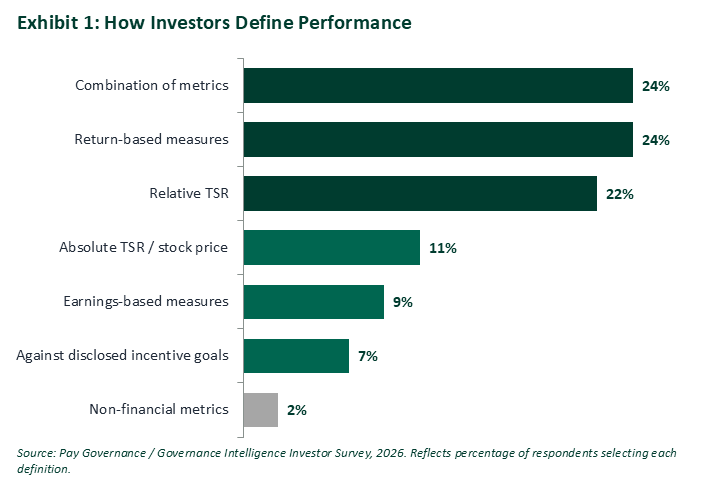
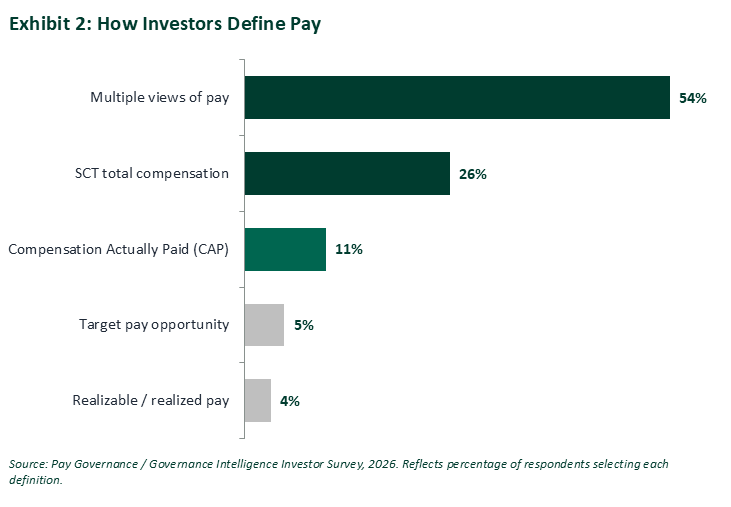
- There is no consensus on how to measure pay or performance. No single performance measure is selected as most important by more than 25% of investors, and 54% consider multiple definitions of pay.
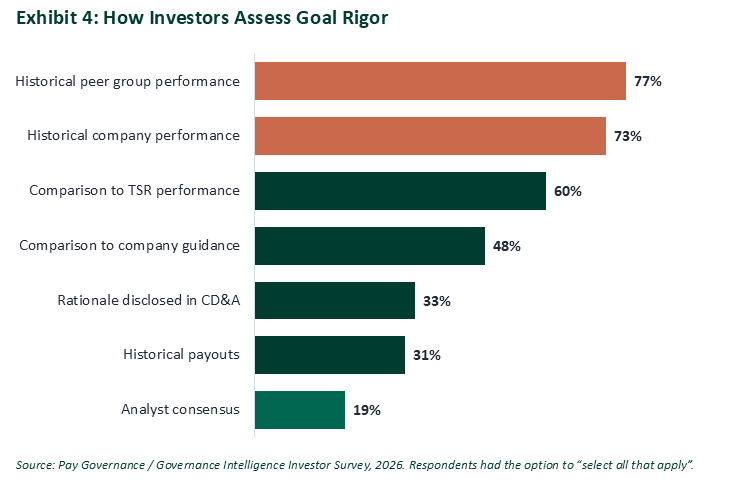
- Goal rigor is judged against historical performance. Investors test goals against historical peer (77%) and company (73%) performance; only 19% say they use analyst consensus.
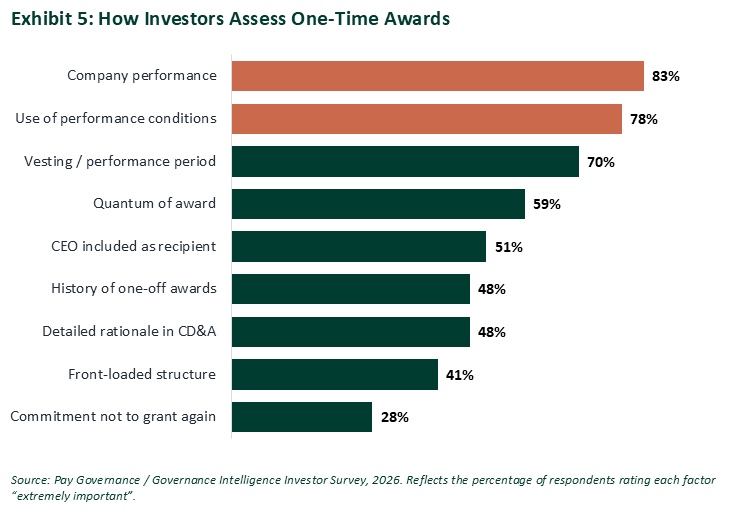
- One-time awards are judged on substance. Company performance (83%) and performance conditions (78%) matter most; a promise not to grant future one-time awards was rated as “not important at all” by 30% of investors, suggesting a disconnect with proxy advisor guidance.
Introduction
This is the second Viewpoint based on the institutional investor survey conducted by Pay Governance and Governance Intelligence. Eighty-three investors with total assets under management of $47.3 trillion, based in North America, Europe, and Asia, participated. Our first Viewpoint, Investor Perspectives on SEC Disclosure Reform, reported broad investor opposition to the SEC’s proposed reductions in executive compensation disclosure.[i]
This Viewpoint turns from what investors want companies to disclose to how they use that information: the inputs on which they rely, how they define pay and performance, the factors that drive their votes, how they judge incentive goal rigor, and how they evaluate one-time awards.
The findings are particularly revealing on pay-for-performance. Most institutional investors that publish proxy voting policies for Say-on-Pay proposals emphasize the importance of pay-for-performance alignment but say little about how they measure it. A couple notable exceptions include State Street Investment Management, whose 2026 policy expressly identifies relative TSR versus the company’s GICS sector and Vanguard, whose 2026 policy indicates that it tests alignment of 3-year TSR and realized pay over a 3-year period as factors in their respective Say-on-Pay assessments.[ii] Our survey goes farther and asks investors directly which measures of pay and performance matter most. The answer: there is no consensus.
How Investors Reach Their Say-on-Pay Decisions
Investors rely on proxy advisors but generally do not outsource the vote
Eighty-four percent of respondents use their own research to evaluate Say-on-Pay proposals, and 60% use proxy advisor input of some kind. When asked to identify their primary input, however, 71% named their own research, compared with 25% that named a proxy advisor recommendation (13% a bespoke policy and 12% the advisor’s standard “house” recommendations). The remaining 4% named the use of other third-party evaluation tools as the primary input.
Reliance on proxy advisors also appears stable. Seventy percent of respondents reported that their reliance has not changed over the past one to three years, while 16% reported an increase and 14% a decrease. We observed similar responses across large and small investors in our survey.
These survey responses are directionally consistent with our analysis of voting by the largest institutional investors, which shows that several major investors frequently reach Say-on-Pay voting outcomes that differ from proxy advisor recommendations. Among 2026 S&P 500 Say-on-Pay votes through June 30, only 17.9% of Vanguard’s opposition votes coincided with ISS opposition and 12.3% with Glass Lewis opposition. For BlackRock, the corresponding figures were 31.2% and 20.5%, respectively, while Fidelity’s were 16.2% and 13.0%.[iii]
| Pay Governance Perspective: Proxy advisors remain an important part of the voting ecosystem, but companies should not assume that satisfying proxy advisor methodologies will secure strong support nor that the status quo will remain. Understanding the policies, voting history, and priorities of the company’s largest holders will be increasingly important, particularly as institutions further develop their evaluation models. |
Pay-for-Performance Is Paramount But Defined Many Ways
An extraordinary 91% of respondents rated alignment between executive pay and company performance as “extremely important,” the top choice of the ten Say-on-Pay factors surveyed. Yet, when investors were asked how they measure that alignment, the answers diverged sharply.
There is no universally preferred measure of performance
Return-based financial measures and a combination of measures were each selected as the most important performance lens by 24% of respondents, followed closely by relative TSR at 22%. Absolute TSR or stock price (11%), earnings-based measures (9%), and performance against disclosed incentive goals (7%) trailed, and only 3% identified non-financial measures. No single measure was selected by even one-quarter of investors.
Nor is there a single definition of pay
The same pattern holds on the pay side. A majority (54%) consider multiple views of pay rather than relying on one definition. Twenty-six percent primarily use Summary Compensation Table (SCT) total compensation and 11% use Compensation Actually Paid (CAP) under the SEC’s pay-versus-performance rules. Few investors rely primarily on target pay opportunity (5%) or realizable/realized pay (4%).
These results help explain why investor voting guidelines tend to be principles-based. The investor community itself does not converge on a single methodology. Notably, the reliance on SCT pay and CAP, both of which depend on the mandated tabular and pay-versus-performance disclosures, reinforces the strong investor opposition to eliminating those disclosures documented in our first Viewpoint in this series.
| Pay Governance Perspective: A program can appear well-aligned under one lens and misaligned under another. Compensation committees should pressure-test pay outcomes using several definitions of pay (granted, SCT, CAP, and realizable) against several measures of performance (relative and absolute TSR, returns, and earnings) rather than relying on any single pay-for-performance calculation. Where alignment depends on the lens, the CD&A should explain which lens best reflects the company’s strategy and why. |
What Else Drives the Say-on-Pay Vote
Beyond pay-for-performance alignment, investors most often rated overall pay structure (68%), disclosure of the rationale for pay decisions (64%), and rigor of incentive goals (62%) as extremely important. Discretion and adjustments (53%), special or one-time awards (47%), and clawback robustness (45%) formed a middle tier. Termination and change-in-control severance (38%), non-CEO pay levels (23%), and perquisites (15%) were least often rated extremely important.
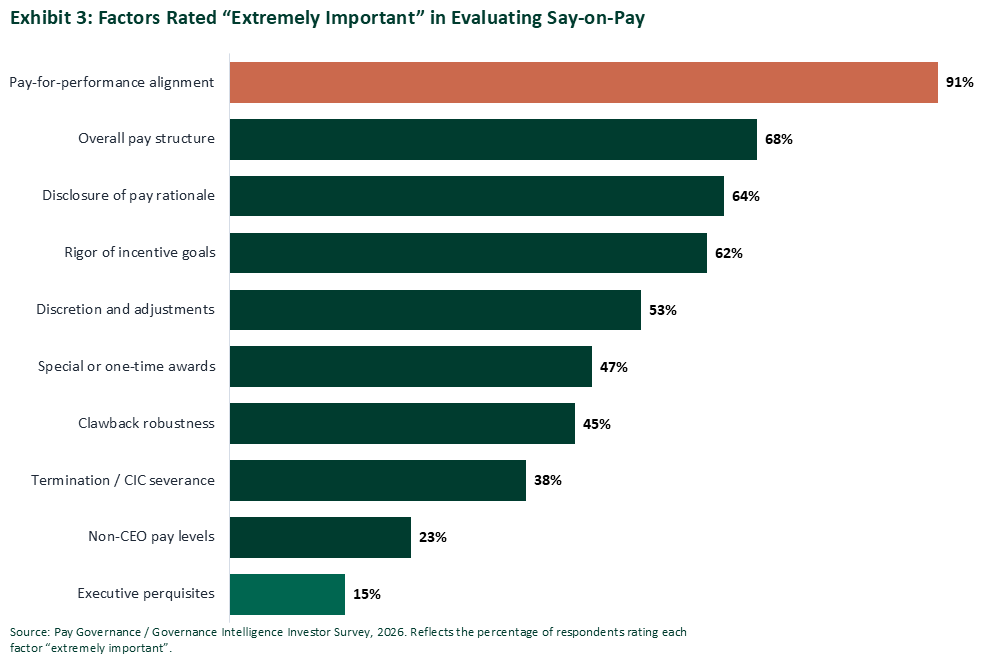
The results suggest a clear hierarchy: outcomes and structure first, followed by the quality of the explanation second, and then specific program features such as severance and perquisites a distant third. Interestingly, smaller investors (under $50 billion AUM) were considerably more likely than larger investors to rate clawback robustness (57% vs. 24%) and severance (50% vs. 18%) as extremely important.
How Investors Judge Incentive Goal Rigor
Goal rigor is among the most difficult elements of a pay program for an outside investor to assess. Respondents most often evaluate goals against historical peer group performance (77%) and the company’s own historical performance (73%). Sixty percent compare goals with TSR performance and 48% with company guidance. Fewer rely on the rationale disclosed in the CD&A (33%) or historical payouts (31%), and only 19% compare goals with analyst consensus.
In short, investors largely judge rigor retrospectively and relatively, asking whether goals are demanding in light of what the company and its peers have actually achieved, rather than relying on the company’s description of its own goal-setting process.
| Pay Governance Perspective: Companies can make it easier for investors to evaluate goal rigor by placing goals in context: how targets compare with prior-year actual results, with historical peer performance, and with external guidance. Where a goal is set below prior-year results, the CD&A should explain the business reasons directly. |
One-Time Awards: Substance Over Labels
Excluding awards related to executive transitions, investors evaluating one-time equity awards focus primarily on company performance (83% rated as “extremely important”), the use of performance conditions (78%), and the vesting or performance period (70%). Award size followed at 59%, and whether the CEO is a recipient at 51%. Fewer investors placed the same weight on the company’s history of one-time awards (48%), detailed CD&A rationale (48%), or front-loaded structure (41%). Only 28% rated a commitment not to grant future one-time awards as extremely important, while 30% said it was not important at all. This suggests such commitments may carry less weight with investors than proxy advisor guidance implies.
| Pay Governance Perspective: One-time awards are not disqualifying in themselves. The most defensible awards are supported by strong company performance, carry rigorous performance conditions, and extend over a meaningful period at a reasonable size. A commitment not to repeat the award is far less persuasive than demonstrating that the award’s economics are aligned with shareholder interests. |
Implications for Compensation Committees
- Know your shareholders, not just the proxy advisors.
- Test pay-for-performance through multiple lenses.
- Preserve the disclosures investors rely on.
- Give investors the context they use to judge goal rigor.
- Treat one-time awards as an investment decision.
| Conclusion: Say-on-Pay votes are not determined using a uniform checklist nor a single pay-for-performance calculation. Investors consider multiple definitions of pay, multiple measures of performance, the rigor of incentive goals, the structure and disclosed rationale for pay decisions, and the circumstances surrounding special awards. Committees that understand how their shareholders evaluate pay, stress-test decisions through those lenses, and disclose the context investors need will be best positioned for strong shareholder support. |
____________