Focus Area
(time prior to IPO) | Description | Why It’s Important |
Compensation Philosophy
(3 to 6 months) | - Review and update (or establish, if necessary) the compensation philosophy covering pay elements, competitive market frame of reference, desired competitive positioning, pay mix, incentive design principles, etc.
| - A compensation philosophy provides direction and guiding principles for delivering pay and program design decisions
|
Peer Group
(3 to 6 months) | - Develop and approve a group of public comparators (“Proxy Peer Group”) for benchmarking pay levels and program design
| - A peer group serves as a reference to inform the compensation committee of relevant competitive practices
|
Executive Pay Levels
(3 to 6 months; can also occur post-IPO, but not recommended) | - Review the range of Proxy Peer Group executive pay levels/pay mixes and incentive designs to understand competitive practices and whether any adjustments are warranted
- External data should be reviewed as one input along with other internal factors (e.g., pay philosophy, executive experience, retention risk, company and individual performance, etc.)
| - Job responsibilities for certain positions inherently change for private vs. public companies and the public environment puts more scrutiny on pay levels for executive positions disclosed in SEC filings
- Further, the company may be adopting a different equity strategy than it employed while private
|
Equity Program Strategy
(3 to 6 months) | - Approve initial approach to equity delivery as a public company including: participation, grant cadence, equity vehicle type, award denomination, mix, vesting, performance conditions, etc.
- Review and discuss annual and new hire equity guidelines to inform the development of an appropriate initial equity share pool reserve (see below)
- Discuss whether awards granted at the IPO are appropriate, including the potential for a one-time award for employees who were instrumental in IPO prep and/or critical to retain
| - Equity award planning: (1) informs public company equity needs, critical in right-sizing the initial equity share pool, (2) encourages management to start planning their equity administration approach (e.g., in-house, co-source, or outsource), (3) promotes governance on managing annual share utilization, (4) helps Finance embed the appropriate compensation expense into the annual operating plan and Legal prepare necessary documentation, and (5) initiates development of an equity communication strategy
|
Initial Equity Plan Reserve
(0 to 3 months) | - Approve the initial share plan reserve (and potentially an automatic annual refresh provision, often referred to as an ‘evergreen’) to be included in the plan document
- Based on the equity program strategy, the compensation committee/management should review:
- Projected share usage over the first several years as a public company based on grant levels, participation, and headcount growth on an absolute basis and relative to market
- Competitiveness of initial share pool and potential dilution, in aggregate
- The pros and cons of including an evergreen provision
| - Establishing an appropriate initial equity plan reserve is crucial to allowing reasonable flexibility in granting equity two to four years post-IPO
- If not sized appropriately, a company runs the risk of depleting its reserve quickly, requiring a request for shareholder approval of an amended reserve well in advance of plan expiration
- On the flip side, an above market initial share pool may unnecessarily dilute shareholders and could be scrutinized by institutional investors and proxy advisors
|
Board of Director Pay Levels
(3 to 6 months) | - Review board of director pay practices (e.g., annual cash and equity retainers, committee chair and member retainers, premiums for board chair and lead directors), along with company specific board structure in order to adopt a competitive board of director compensation program
| - A competitive board pay program helps facilitate recruitment of independent outside directors to a public company board
- It is also important that shareholders do not view the director pay program as egregious relative to market norms
|
Severance Benefits (both change-in-control and non-change-in-control)
(3 to 6 months) | - Review and discuss employment agreements and/or related companywide policies covering various termination scenarios and associated severance benefits
- Determine whether specific termination provisions, especially change-in-control severance benefits should be adopted; if yes, consider adopting severance provisions before or contingent on the IPO
| - A new equity strategy, changes to cash compensation, and the transition into a public company environment can warrant the need to revisit severance benefits. This provides assurance that executives will be protected in the event of a termination that is out of their control
- Some private companies employ termination benefits on an individualized basis and use the IPO event to harmonize benefits across executive levels and ensure market competitiveness
- Adopting severance benefits before the IPO can alleviate triggering ad-hoc SEC filings post-IPO, as well as provide shareholders upfront transparency if it is decided severance benefits will be provided to executives
|
Long-Term Incentive Plan Documentation
(1 month) | - Review and approve the long-term incentive plan document and equity award agreements
- In addition to the initial share pool reserve and evergreen (discussed above), key provisions that should be reviewed, include: share recycling methodology, board of directors grant limits, treatment of equity in termination scenarios, change-in-control protections, shareholder approval for option repricing, dividend treatment, etc.
| - The plan document should outline governance and administrative guidelines for the delivery of long-term incentives, while providing flexibility for the company and compensation committee to make future design decisions based on then current circumstances
- Given the administrative burden, time, expense, and potential scrutiny associated with obtaining shareholder approval on a new equity plan or replenishing the equity plan pool, we view the approval of a long-term incentive plan document as an essential task before going public
- Further, it is common for companies to start granting annual equity awards within one year of going public
|
Employee Stock Purchase Plan (“ESPP”) Documentation
(1 month) | - Consider the implementation of an ESPP and required documentation and plan provisions (e.g., initial share pool, discount, look back period, etc.)
- Review and approve ESPP (if desired), which does not need to be implemented right away after the IPO. The company can take more time to determine the right time to implement
| - Similar to a long-term incentive plan, approving an ESPP before the IPO eliminates the need to submit an approval request to public shareholders and allows for implementation, when ready, at or after IPO
|
Disclosure
(1 month) | - Oversee drafting of compensation-related disclosures in draft and final registration statements and other IPO-related filings (which may include a full compensation discussion & analysis section depending on filing status)
| - The first public SEC filing begins to establish the narrative around executive pay levels and practices, and it is important that the full board and compensation committee are aligned with what will be communicated to current and potential investors
|
Compensation Committee Governance Norms
(3 months pre-IPO through post-IPO) | - Establish the Compensation Committee charter
- Prepare an annual calendar of committee meetings, core responsibilities, and meeting agendas
- Confirm the executive compensation advisor’s independence and engagement by the committee
- Understand investor and proxy advisor roles and their executive compensation proxy voting guidelines for public companies and Say on Pay environment. Note, this step is typically more important for large, accelerated filers due to future Say on Pay shareholder proposals and in-depth SEC proxy disclosure requirements
| - Helps ensure good governance over executive compensation decisions
|



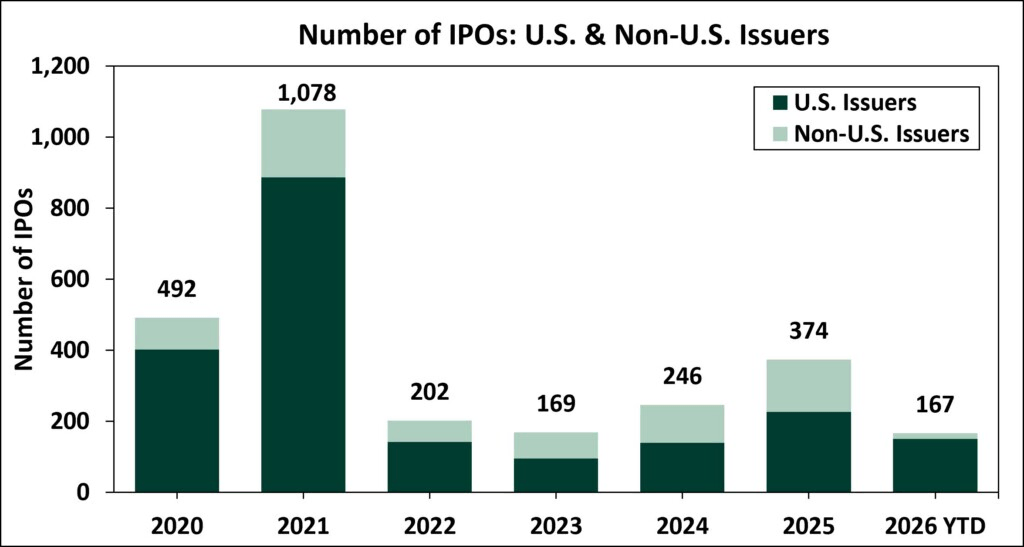 Through early June, this year’s initial public offering (“IPO”) activity is on pace to surpass the 374 total IPOs reported by the Securities and Exchange Commission (“SEC”) in 2025. This would mark the third year of an increase in the number of IPOs since 2022’s sharp decline from 2021’s record high.