Less Disclosure, Not Less Information: Defining Essential Executive Compensation Disclosure

KEY TAKEAWAYS
- The policy question is shifting. If SEC requirements are reduced, companies will need to decide which information remains essential to investors rather than simply defaulting to the new legal minimum.
- The answer is not today’s full disclosure framework. The opportunity is to retain the information investors use to evaluate pay and performance while removing duplication, boilerplate and low-value process detail.
- A practical alternative is available. The Essential Executive Compensation Dashboard is a standardized two-page exhibit that works with the Summary Compensation Table to preserve decision-useful information in a shorter, more visual format.
Introduction
Executive compensation disclosure has expanded with nearly every rulemaking cycle since 2006. Much of the resulting information is useful, but the current framework also contains repetitive narrative, tables with overlapping information, and process descriptions that can obscure the central question: how did the company link executive pay to performance and strategy?
Potential SEC reforms create an opportunity to rethink the architecture of disclosure. Our earlier Viewpoint, “Investor Perspectives on SEC Disclosure Reform”, summarized the SEC proposal and reported detailed survey findings showing broad investor support for retaining decision-useful executive compensation information. This Viewpoint does not repeat that analysis. Instead, it addresses the next question: if disclosure requirements are reduced, what should companies continue to provide, how can they provide it more efficiently, and will the reimagined disclosure be allowable under the SEC’s disclosure requirements?
A Better Objective: Less Disclosure, Not Less Information
The objective should not be to preserve every current requirement. Nor should companies assume that reduced requirements justify eliminating information shareholders use to assess compensation outcomes and board accountability. The more durable approach is to separate essential information from the disclosure conventions that have accumulated around it.
- Preserve the data needed to understand what executives were awarded, what they earned and why.
- Condense explanations of philosophy, process and governance where they do not change materially from year to year.
- Present pay and performance information in a consistent sequence using tables, charts and plain-language commentary.
Separating the Essential from the Boilerplate
The distinction below is intentionally practical. It focuses on the information needed to evaluate annual and long-term incentive outcomes, the relationship between pay outcomes and performance, and the principal governance protections surrounding the program.
| Essential to Investors | Candidates for streamlining |
|---|---|
| Pay levels and pay mix for each named executive officer | Generic or aspirational descriptions of compensation philosophy |
| Incentive metrics, goals, actual results, payouts and material use of discretion | Narrative that restates the same information already shown in tables |
| Rationale for material decisions, special awards and significant program changes | Extended process descriptions that change little from year to year |
| Relationship between pay outcomes and company and shareholder performance | Lengthy pay-versus-performance narrative and duplicative required measure lists |
| Outstanding equity value, vesting status and completed performance-cycle outcomes | Multiple equity tables that present the same awards from different perspectives |
| Stock ownership, clawbacks, risk oversight, severance and change-in-control economics | Inactive-plan tables or governance descriptions with no material current-year relevance |
The Essential Executive Compensation Dashboard
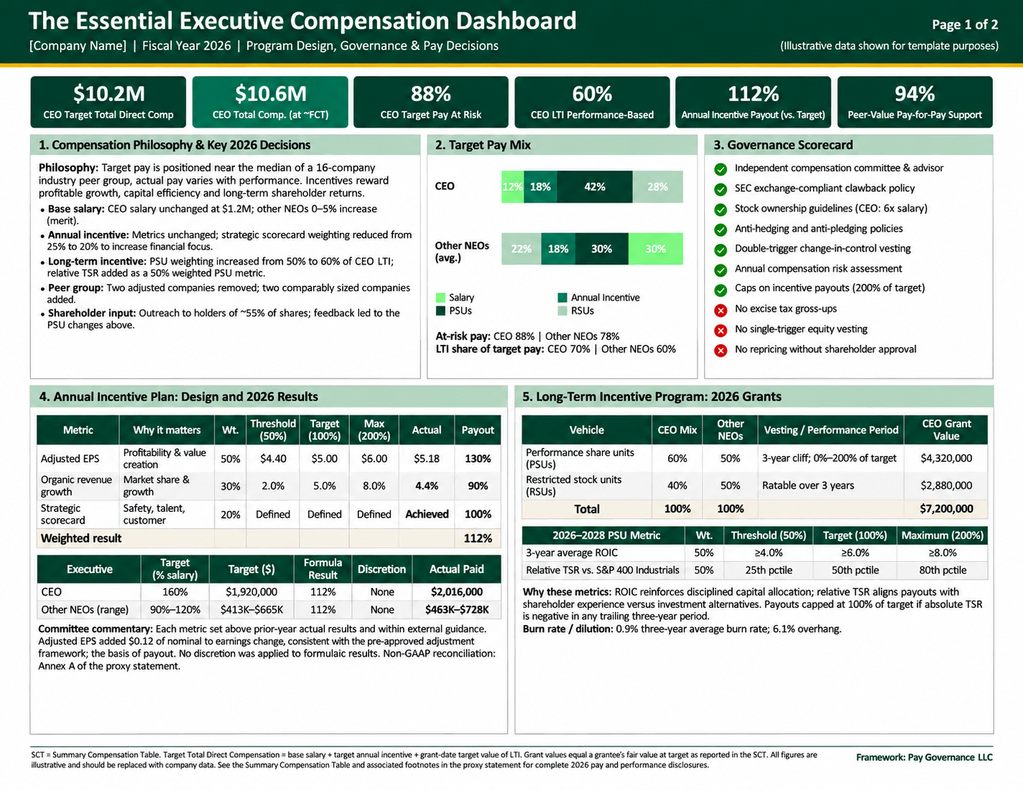
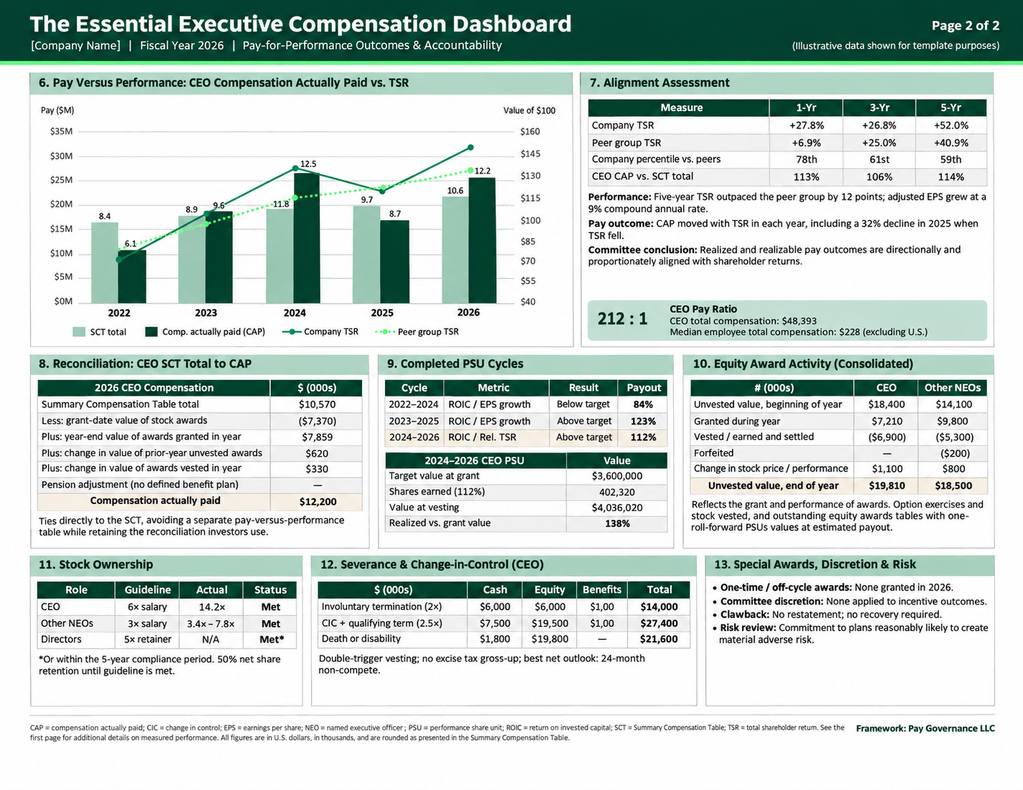
We propose a standardized two-page Dashboard designed to accompany the Summary Compensation Table. The Dashboard would not recreate the current disclosure regime in miniature. It would consolidate the most decision-useful information, eliminate overlaps and place board judgment alongside the relevant quantitative results. The scope of the disclosed data, such as Pay Versus Performance, CEO Pay Ratio, and forward-looking performance share targets, may vary based on company-specific factors, including incentive plan complexity and shareholder base.
- Page 1 – program design and annual decisions. Headline pay statistics, target pay mix, material program changes, governance safeguards, annual incentive results, and long-term incentive grant design.
- Page 2 – pay outcomes and accountability. Multi-year pay and performance, reconciliation of Summary Compensation Table pay to compensation actually paid, completed performance cycles, consolidated equity activity, ownership, severance, and special awards or discretion.
The illustrative Dashboard at the end of this Viewpoint uses hypothetical figures solely to demonstrate structure and presentation. A common order and terminology would improve comparability across companies over time, while a table-based design would support machine-readable tagging.
Why the Dashboard Is Different
It is selective, not additive. The Dashboard is meant to replace duplicative narrative and overlapping tables, not sit on top of the existing framework as another summary.
It connects design to outcomes. Annual and long-term incentive designs appear alongside goals, actual results, payouts, and any discretion, making the Committee’s decisions easier to evaluate.
It reconciles different views of pay. A concise bridge from Summary Compensation Table pay to compensation actually paid helps readers understand how grant-date compensation values are adjusted to reflect subsequent changes in equity award values and other required items.
It makes accountability visible. Ownership, clawbacks, risk oversight, severance, change-in-control arrangements and special awards are presented in one place rather than dispersed throughout the proxy.
It supports comparability without eliminating judgment. Standardized categories make disclosure easier to navigate, while brief company-specific commentary preserves context for unusual decisions or outcomes.
Implications for Compensation Committees
- Treat regulatory disclosure relief as an option, not an instruction. The Committee should determine which information remains important to shareholders and necessary to understand the company’s compensation program.
- Use the transition to remove clutter. Start with repetitive narratives, overlapping equity presentations and immaterial process descriptions before removing substantive pay and performance information.
- Preserve a clear record of judgment. Concise disclosure should still explain material discretion, special awards, significant design changes and outcomes that may otherwise appear misaligned with performance.
- Engage major shareholders before materially reducing disclosure. Investor priorities may differ by ownership profile, and company-specific feedback can identify which elements are truly decision-critical.
- Design for usability. A shorter proxy is valuable only if investors can quickly locate consistent, comparable and sufficiently complete information.
- Consult with legal counsel. Inclusion of the Essential Executive Compensation Dashboard should be reviewed by legal counsel for compliance with the disclosure rules.
Conclusion
The strongest case for disclosure reform is not that investors need less information. It is that they should not have to work through duplicative tables and boilerplate to find the information that matters. The Essential Executive Compensation Dashboard offers a practical middle ground: retain the quantitative and company-specific information needed to evaluate pay and performance, while materially reducing length, repetition and compliance-driven narrative.
| If the SEC provides companies greater flexibility, compensation committees will have an opportunity to improve disclosure rather than merely reduce it. A concise, standardized and decision-oriented presentation can lower burden while preserving transparency and investor confidence. |
Disclaimer: This Viewpoint is for informational purposes only and does not constitute legal advice.