IPO Readiness: Establishing an Initial Equity Plan Share Reserve

Executive Summary
KEY TAKEAWAYS
- Equity strategy, long-term incentive (“LTI”) plan documentation, and initial share pool reserve are critical compensation decisions when planning for an initial public offering (“IPO”)
- Setting an appropriate reserve with potential evergreen provisions provides flexibility in administering equity grants in the initial years as a public company
- Pay Governance reviewed equity plans at 80 early-2026 U.S. IPOs and compared the results with those from our 2022 IPO Readiness: Establishing an Initial Equity Program and Share Reserve Pool Viewpoint. High-level findings include:
- Share pool reserve: The median at-IPO reserve is 8.9% of fully diluted shares outstanding (“FDSO”), slightly above the 2022 median of 8.7%
- Overhang at IPO: Median overhang is 15.1% of FDSO, a modest increase from our 2022 study (14.4%)
- Evergreen provisions: Automatic annual refresh provisions (i.e., evergreens) remain highly prevalent at IPO, appearing in 80% of plans reviewed, representing a slight increase from our 2022 study. The most common evergreen amount was 5% of common shares outstanding (“CSO”)
- Industry differentiation: Life sciences and technology companies continue to be heavier equity users than other industries
Note: Refer to the last section of this Viewpoint for the definitions of key terms referenced throughout this article.
“Establishing an initial equity plan share reserve at IPO requires a thoughtful balance of (i) equity strategy driven by compensation philosophy, (ii) projected equity needs with flexibility to account for potential uncertainty in the public environment, and (iii) investor expectations around dilution. An undersized reserve and inadequate (or no) evergreen may result in needing to seek shareholder approval for additional shares well before plan expiration. Conversely, a reserve that is too large may result in unnecessary shareholder dilution and potential scrutiny from investor groups. Finally, when right-sizing the initial equity share reserve pool (e.g., October) and including an evergreen provision (e.g., January), it is important to consider the timing of the IPO and the first evergreen replenishment to ensure that potential dilution remains at a reasonable level.”
Introduction
This Viewpoint is the second article in our 2026 IPO readiness series. The first article, IPO Readiness: Compensation Committee and Governance Planning Checklist, provided a checklist of key compensation-related considerations for IPO planning. A key task within that checklist – and one that is virtually essential to complete before the IPO – is establishing an equity program and determining the initial share pool reserve.
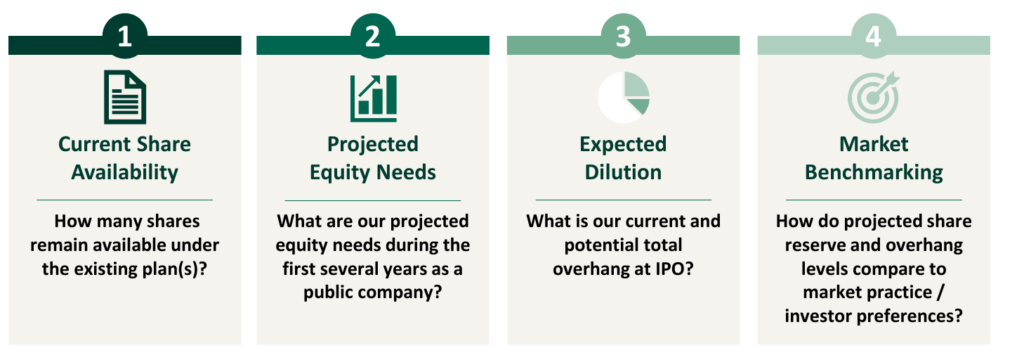
As highlighted in the framework below, developing an effective equity strategy requires balancing internal and external considerations to establish a share reserve that enables the Compensation Committee and Board to administer a market-competitive equity program while maintaining flexibility to adapt to evolving business needs, talent strategies, and investor expectations.
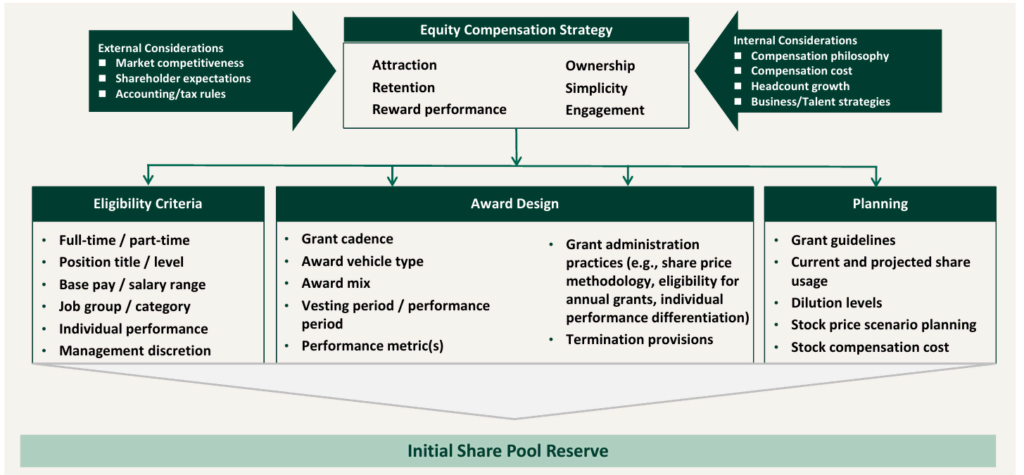
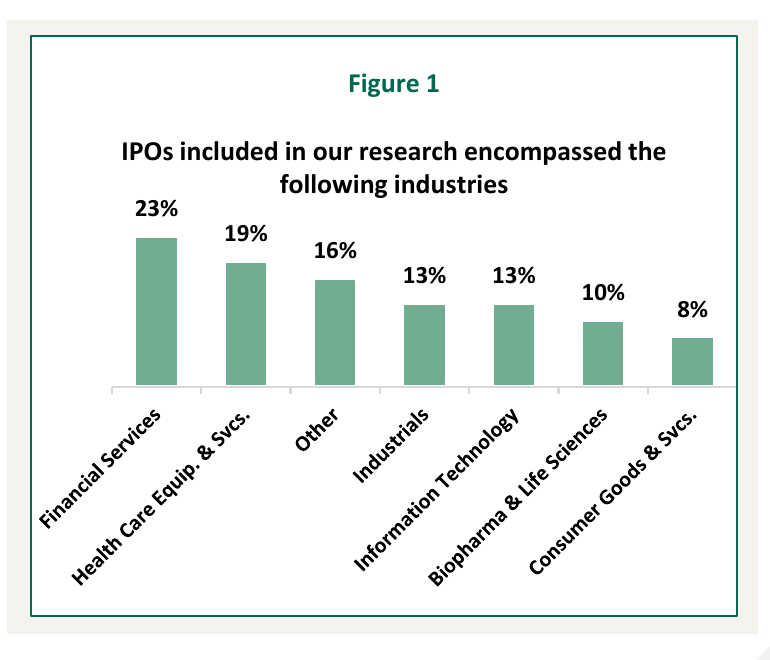
To help understand the external considerations, Pay Governance researched 80 U.S. IPOs completed between January 2025 to April 2026 with a market capitalization greater than $50 million and compared the findings to our research conducted in 2022 (IPO Readiness: Establishing an Initial Equity Program and Share Reserve Pool). This year’s research focused on the following key aspects of an equity strategy:
- Initial equity plan share pool reserve
- Total overhang at the time of IPO
- Prevalence and size of evergreen provisions
Summary of Key Findings
Our research identified several notable findings. The figures below reflect median values only.
Initial Share Pool Reserve at IPO (% of FDSO)
Overall Analysis – All IPO Companies:
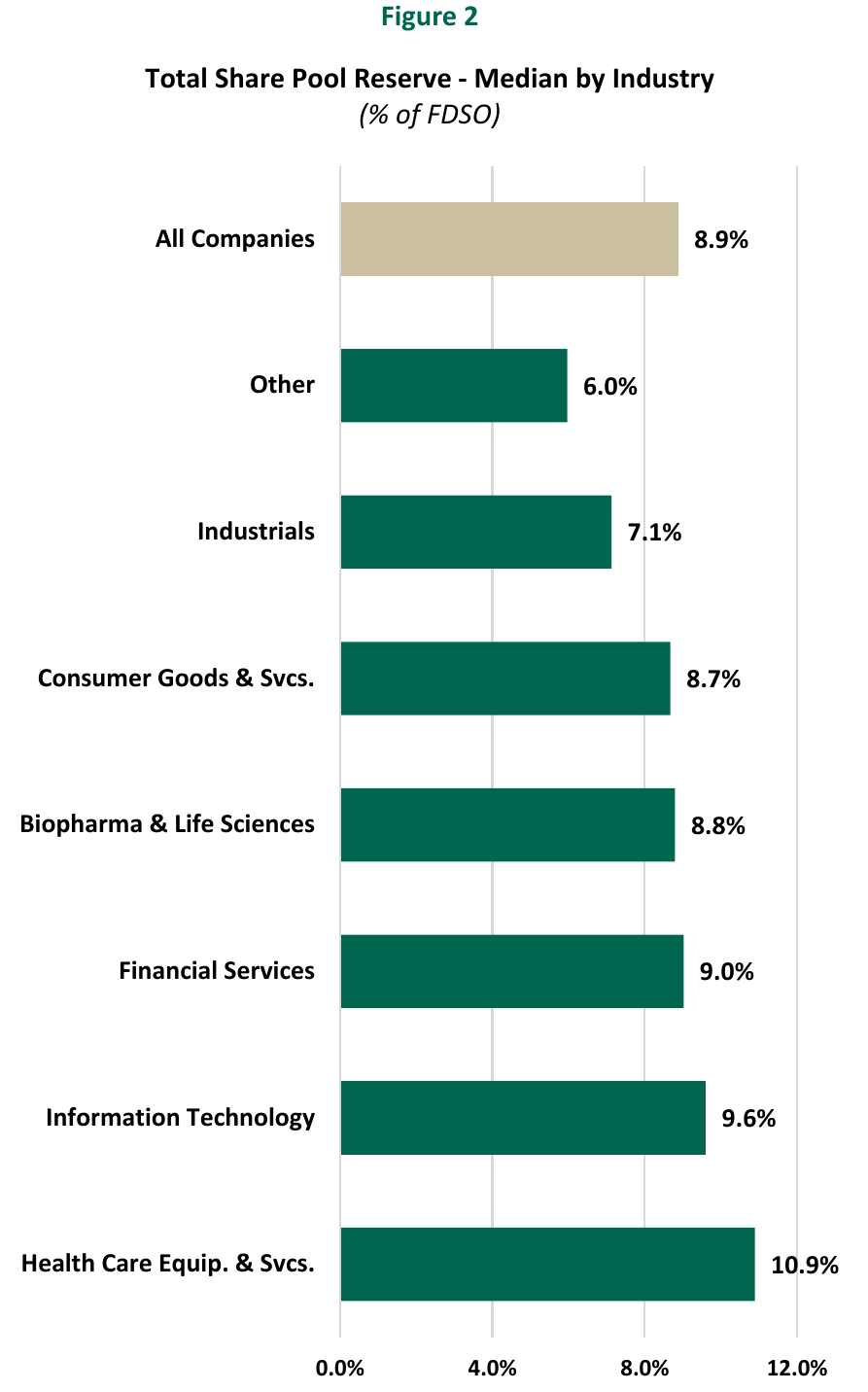
- Median share pool reserve of newly approved equity plans is 8.9%, compared to 8.7% in our 2022 study
Industry Analysis:
- Differences in share pool reserve levels are relatively modest, with the Industrials companies generally utilizing smaller reserves (~7%) than most other industries
Total Overhang (% of FDSO)
Overall Analysis – All IPO Companies:
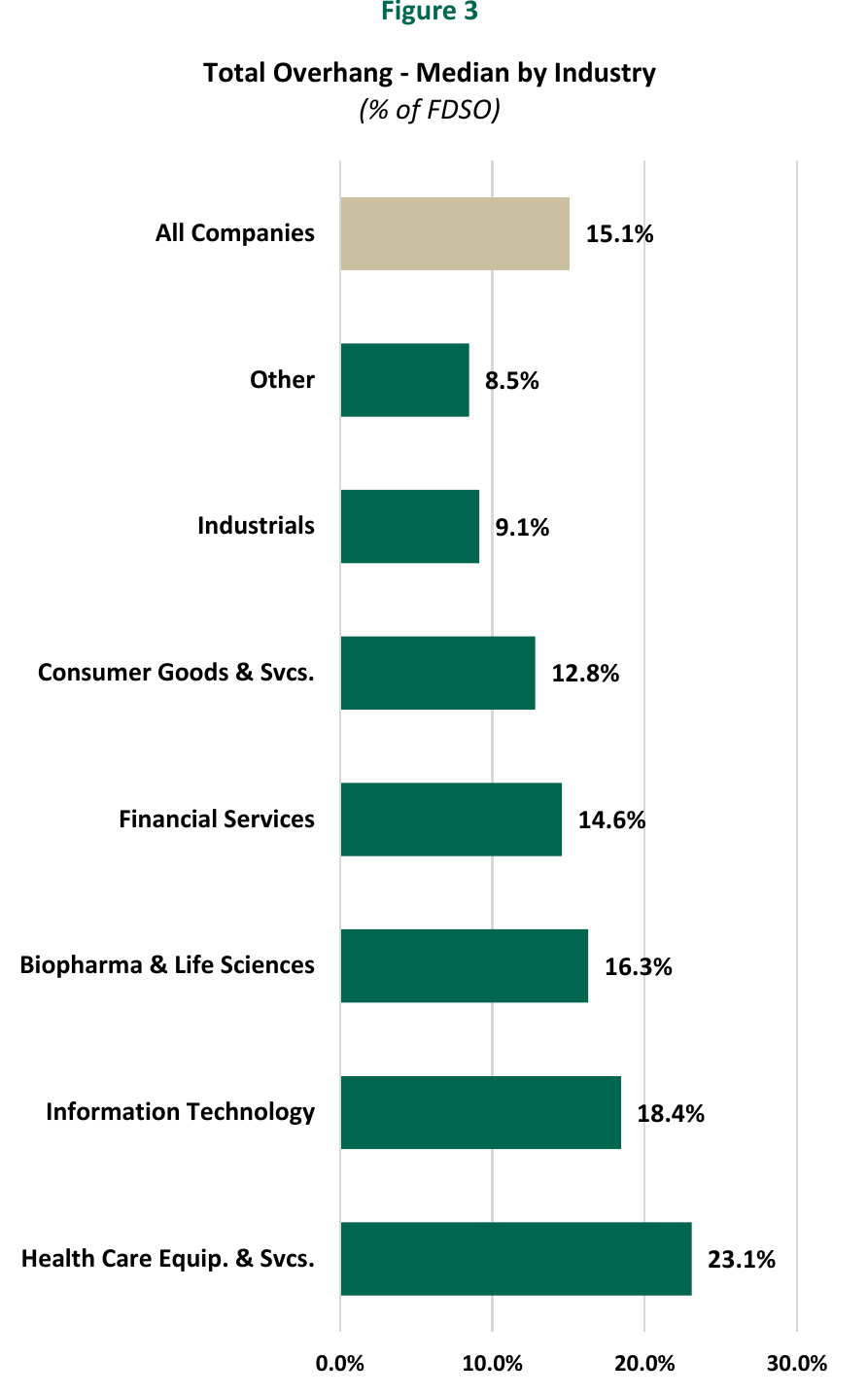
- Median total overhang at IPO is 15.1%, compared to 14.4% in our 2022 study
Industry Analysis:
- Variations observed across industries were primarily driven by differences in outstanding equity at the time of IPO (e.g., due to higher pre-IPO equity usage combined with lack of liquidity opportunities while private), as initial share pool reserves are more consistent across industries (see Figure 2)
- Companies with broad-based, equity-intensive compensation philosophies—such as life sciences companies, where stock option grants are highly prevalent—typically have higher levels of total overhang at IPO
Prevalence and Size of Evergreen Provision (% of CSO)
Overall Analysis – All IPO Companies:
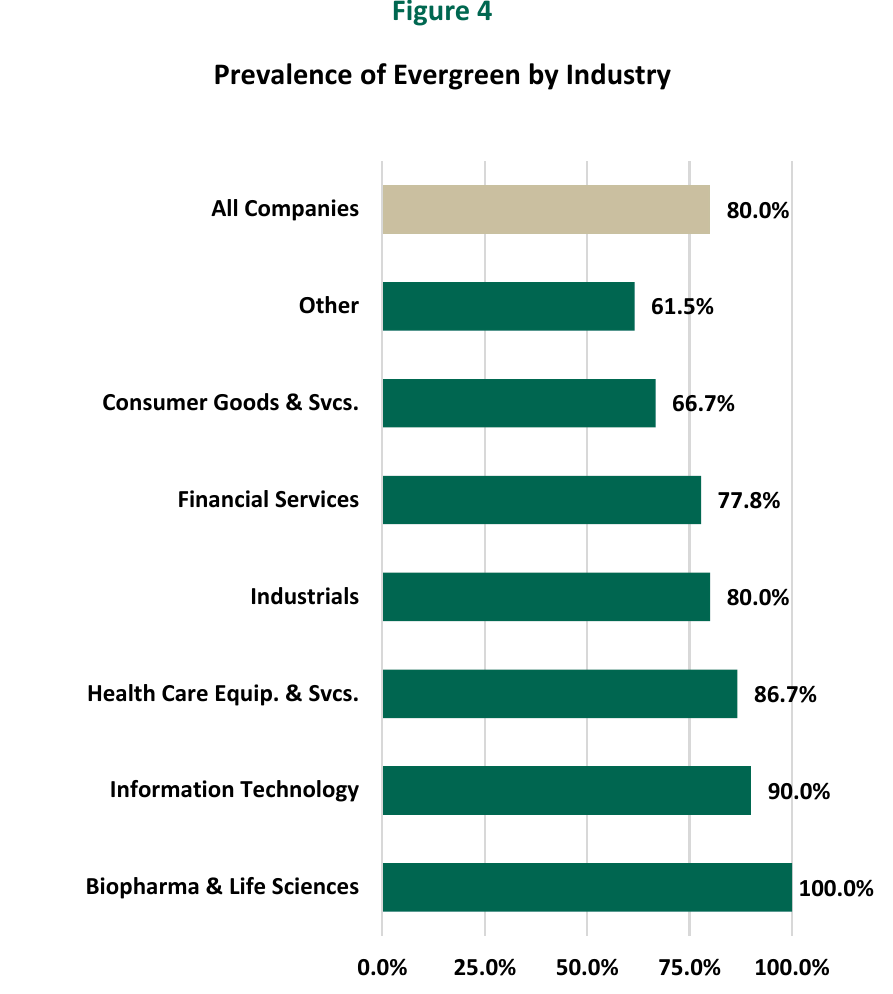
- Evergreen prevalence of 80.0% reflects a +6.6 percentage point increase from our 2022 study
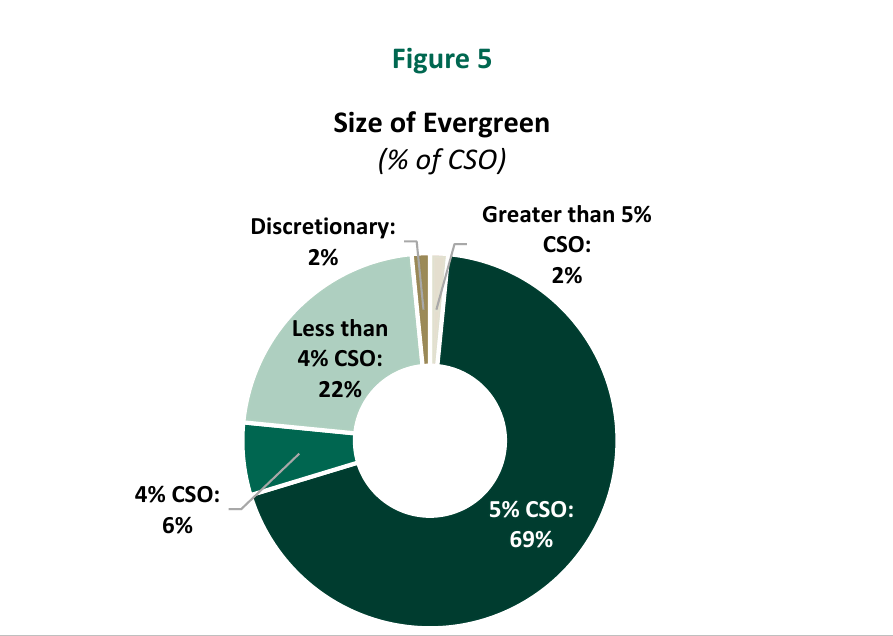
- The most common annual equity refresh amount (i.e., evergreen) is 5% of CSO
- Prevalence of evergreen provisions drops significantly for public companies once they seek shareholder approval for a new or amended equity plan – driven by evergreens being viewed unfavorably by proxy advisory firms and institutional investors
Industry Analysis:
- There was limited differentiation in evergreen size – the most common evergreen size was 5% across all industries and generally ranged between 1% and 5%
Note: Evergreens are commonly expressed as a percentage of CSO as they are designed to replenish the share pool reserve based on currently issued and outstanding shares (though, we have seen different approaches to defining evergreen levels), whereas dilution metrics, such as overhang, are commonly expressed as a percentage of FDSO to capture the full potential dilutive impact of outstanding awards and available shares.
Conclusion
The appropriate equity strategy ultimately depends on each company’s unique circumstances, such as financial growth expectations, hiring needs, competitive talent dynamics, and compensation philosophy. Nevertheless, recent IPO practices provide a useful benchmark for evaluating whether projected share pool reserve levels, overhang, and evergreen provisions are likely to be viewed as reasonable by future investors.
Our analysis suggests that while there are some commonalities across industries (the importance of developing an equity strategy, the timing of implementing a new share pool reserve, the prevalence of evergreen provisions, etc.), there are also key differences. Companies should be mindful of how their equity strategy and allocation levels compare to those of peers in their industry, as these dynamics can serve as indicators of shareholder expectations. For example, we find that it is more typical for companies in equity-intensive industries to adopt larger share pool reserves and carry higher overhang levels – due in part to cash constraints, for example.
Questions to Consider When Establishing an Initial Share Pool Reserve
Definition of Key Terms
| Term | Definition |
|---|---|
| Common Shares Outstanding (“CSO”) | Total number of company shares held by shareholders – does not include warrants, preferred ownership, shares reserved for equity plans, unexercised stock options, unvested awards, and other potentially dilutive securities |
| Fully Diluted Shares Outstanding (“FDSO”) | Sum of common shares outstanding, outstanding equity awards, outstanding warrants, and total post-IPO share pool reserve available for future grant |
| Total Share Pool Reserve | Pool of shares within the equity plan that are available for issuance. Reflects the sum of pre-IPO shares continuing to be available (if applicable) and the new shares reserved at IPO (typically understood as a % of FDSO) |
| Total Overhang | The sum of (i) outstanding/unexercised stock options, (ii) unvested full value shares, and (iii) total share pool reserve (typically understood as a % of FDSO) |
| Evergreen Provision | Equity plan provision calling for the automatic replenishment of a certain number of shares (usually understood as a % of total shares outstanding) at the start of every year unless overridden by the Committee/Board |
General questions about this Viewpoint can be directed to Brian Lane (brian.lane@paygovernance.com) or Tara Tays (tara.tays@paygovernance.com).